I Went On a $5,000 Off-Ship Machu Picchu Excursion. Here’s What Happened
 I Went On a $5,000 Off-Ship Machu Picchu Excursion. Here’s What Happened
I abandoned my ship mid-cruise for three days to go on an off-ship Machu Picchu Excursion. But after I booked the eye-wateringly expensive $5,000 excursion and started looking at the details, I started to appreciate just how much could go wrong.
Welcome aboard, I’m Gary Bembridge and join me to discover if I went on an incredible never-to-forget adventure or had to write this off as a costly mistake serving up an underwhelming experience.
I quickly realised that going on a Machu Picchu Excursion was not simple. It’s over 300 miles inland, deep in the Andes, and getting there requires a tightly choreographed chain of flights, buses, trains and timed entry tickets all going to plan.
Miss one connection, hit one delay, or succumb to altitude sickness, and the whole costly thing could unravel.
I’ve always wanted to see Machu Picchu, and it was a key reason I booked the 31-night South America cruise on Holland America, as the ship stayed in Lima for 2.5 days making it possible.
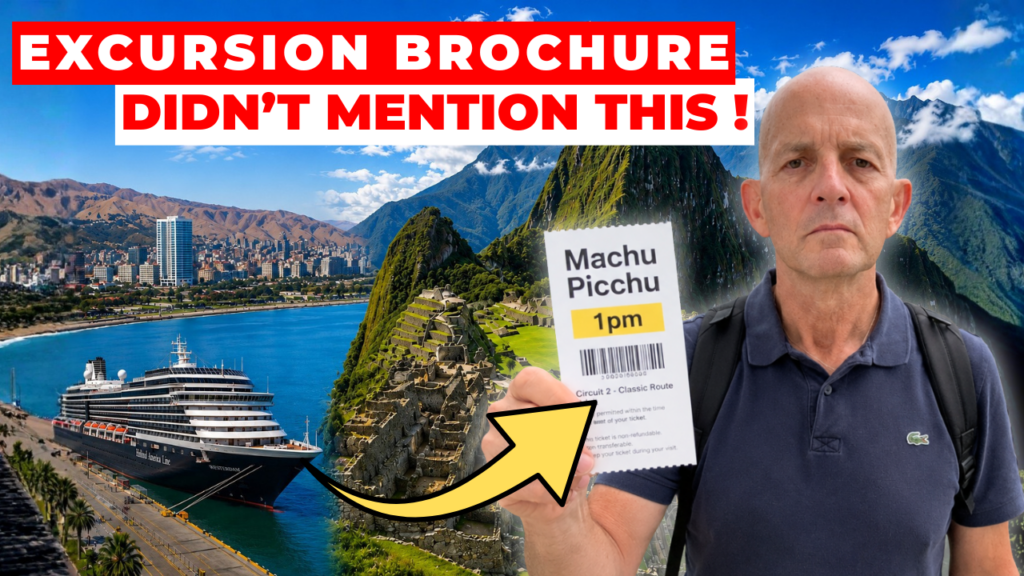
I went all in on Holland America’s most expensive “Gold” Machu Picchu Excursion option. Because that one included travelling on what’s considered one of the most luxurious trains in the world, the Belmond Hiram Bingham, run by the same company behind the Orient Express and Royal Scotsman.
But was this a good decision, you will hear shortly.
The Breathless Arrival in Cusco
The adventure began the second the Holland America’s Oosterdam docked in Callao, Lima. We were off the ship by 6:30am, working our way through the renowned Lima traffic to the airport for a 90-minute flight to Cusco.
This was just the first of four stages to get to Machu Picchu over the coming two days.
Also looming over me as we headed off was that it was March, the tail end of the rainy season, and the forecast for the days ahead looked poor.
I was warned in the pre-excursion briefing that the transition from Lima to Cusco can be brutal. We went from sea-level to the over 11,000-foot peaks of Cusco. At that height, oxygen levels are roughly 30% lower than at the coast.
I’ll be honest: I hadn’t prepared. In the days before the trip, I spoke to others who had arranged altitude sickness pills; one who’d been before told me they were essential.
So, as departure drew closer, I stressed that my lack of preparation would cost me as no one knows how their body will react to the “thin air” until they are in it. If I reacted badly, my $5,000 trip could be over before it truly began.
Symptoms of altitude sickness like headaches, nausea, and dizziness can take days to subside, and I didn’t have days on this excursion to acclimatise.
To add a further problem, I’d developed a cold the day before. I was already feeling a little run down, and I feared the altitude would turn that into exhaustion.
After landing in Cusco, we were split into groups of 10 people each with a guide and minibus for the duration of the trip. We headed for an included lunch and then went on a city tour which included a local farm with Llamas and Alpacas.
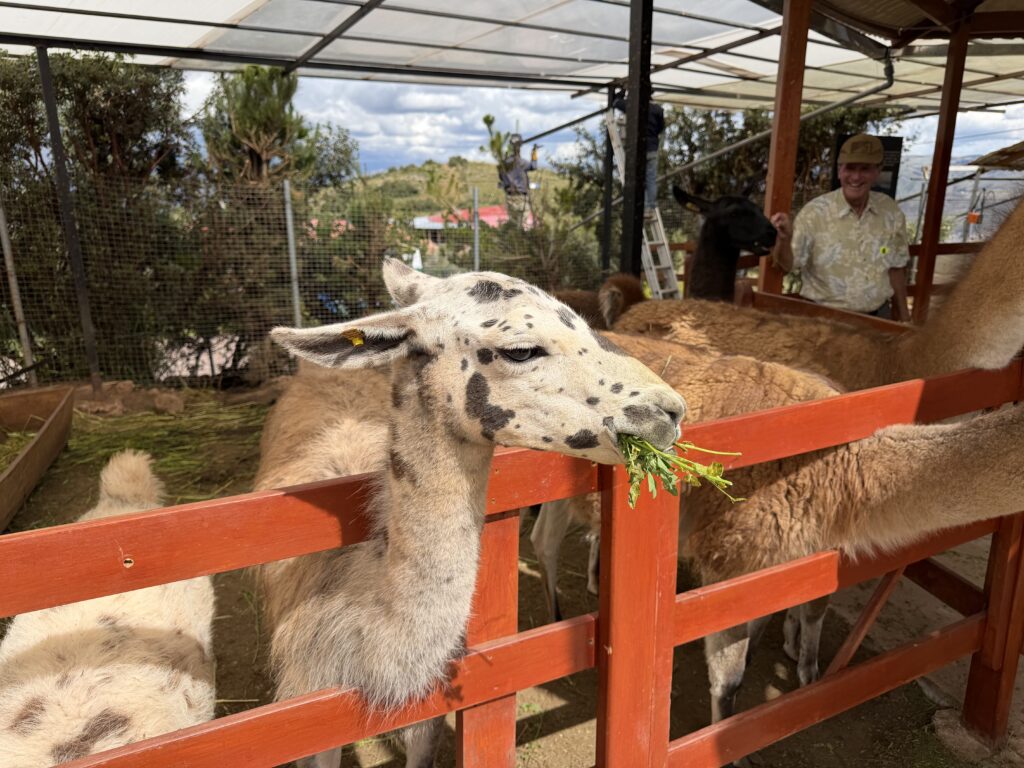
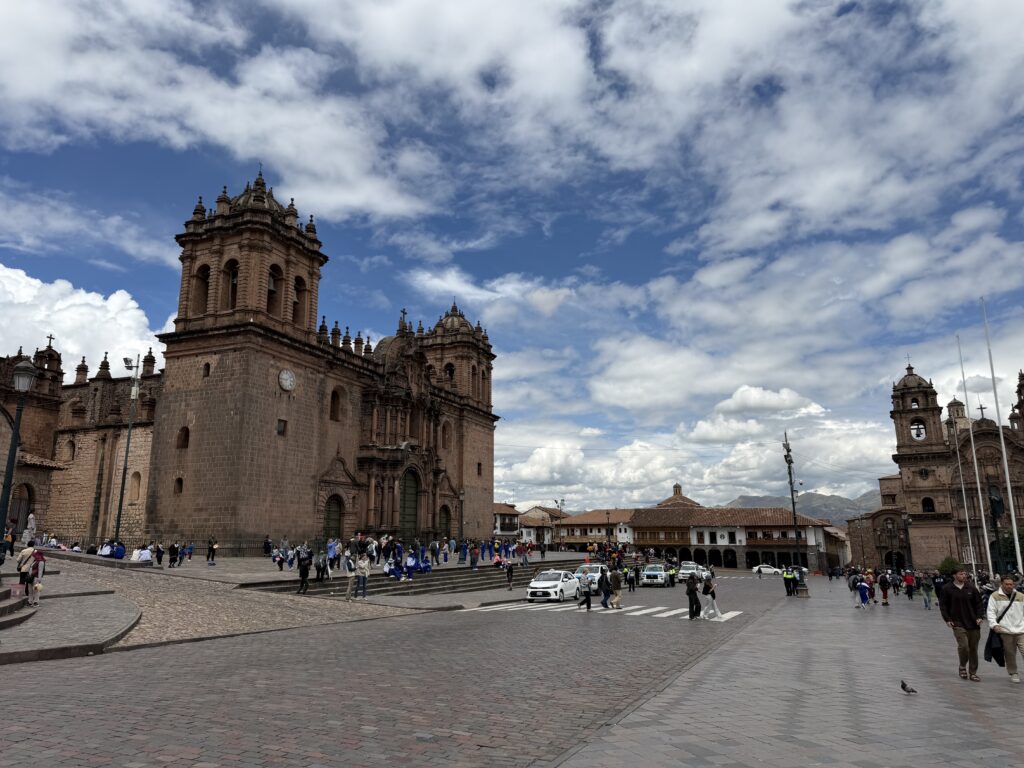
Cusco was beautiful, it was the historic Inca capital from the 13th Century until the 1533 Spanish conquest, who eventually built a colonial city over the Inca ruins.
But the altitude started claiming victims during the afternoon. One lady in our group was in visible distress, eventually throwing up at the end the city tour. Later that evening, a younger boy in the group was also ill.
Our guide’s advice? Drink regular Coke for the sugar and caffeine, stay hydrated, and eat chocolate. He warned against the pills, suggesting also suggested trying local remedies like chewing coca leaves or coca and mint tea instead.
I admit I did spend the whole afternoon checking in with myself on how I was feeling and if I had any symptoms. Though I was feeling fairly good, if a bit tired, and attributed it more to my cold than altitude.
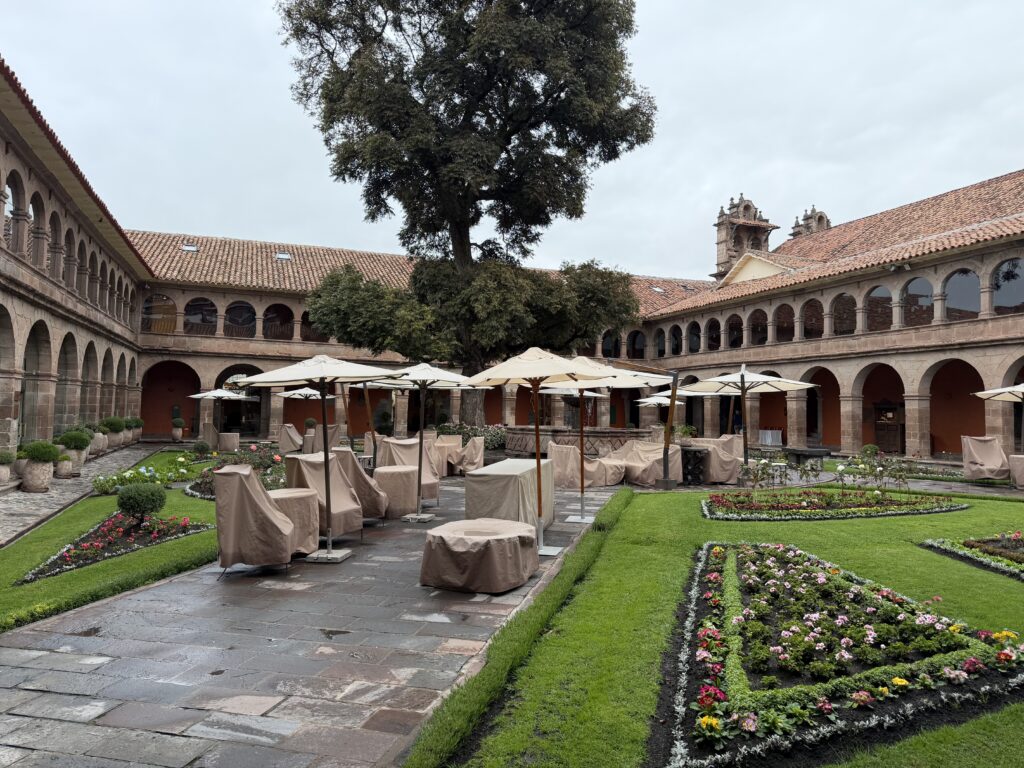
But I was relieved when late afternoon we checked into the stunning Belmond Hotel Monasterio included in the excursion, our home for 2 nights, as I could rest and relax.
This is a 5-star converted 16th-century monastery. It was stunning, with courtyards and cozy rooms. They advertise that most of their rooms there are oxygen-enriched to help mitigate altitude effects, though mine wasn’t.
After a traditional Peruvian dinner with local dancers for our group of around 40, I headed to bed feeling a bit sluggish. Though I was actually more worried about our guide’s final warning: the weather forecast was not promising, stressing we must bring a raincoat, and even suggested bringing spare socks and even trousers as the ones we would be wearing were likely to get wet.
I went to sleep wondering how much of Machu Picchu perched high up in the mountains I would get to see through the rain and clouds. And how enjoyable it would be in a rainy day.
The Journey to the Clouds
I woke up on day two with a thumping headache. I couldn’t tell if it was my cold or the altitude, but it cleared after breakfast either way.
Today was the big day, but it was a finely balanced and tightly timed logistical minefield as we ventured on the next 3 stages to get to Machu Picchu.
First, we had to take a bus through the Sacred Valley to the train station, then catch the train to Aguas Calientes, followed by a white-knuckle bus ride up a 1,000-foot cliff to the ruins. It all needed to go to plan as we were told we had a timed entry ticket for 1pm with only a 30-minute grace period for entry.
The clouds were dark and threatening too, and our guide kept checking everyone had brough raincoats and gear.
Because I was travelling in the rainy season, we couldn’t take the train directly from Cusco as it only goes from there between May and December instead, we had to drive 90 minutes to the Belmond’s Rio Sagrado station.
We pulled in just as the train was ready to depart. We had to hurry past the live Peruvian band and the welcome champagne and canapes in the boarding lounge to get on board.
The Belmond Hiram Bingham train is named after the man who brought these ruins to world attention in 1911.
It’s a 1920s-style Pullman coach train with mahogany panels and brass fittings. It carries just 84 guests in two dining cars, with a Bar / Observation Deck Carriage too. It felt luxurious and up-market.
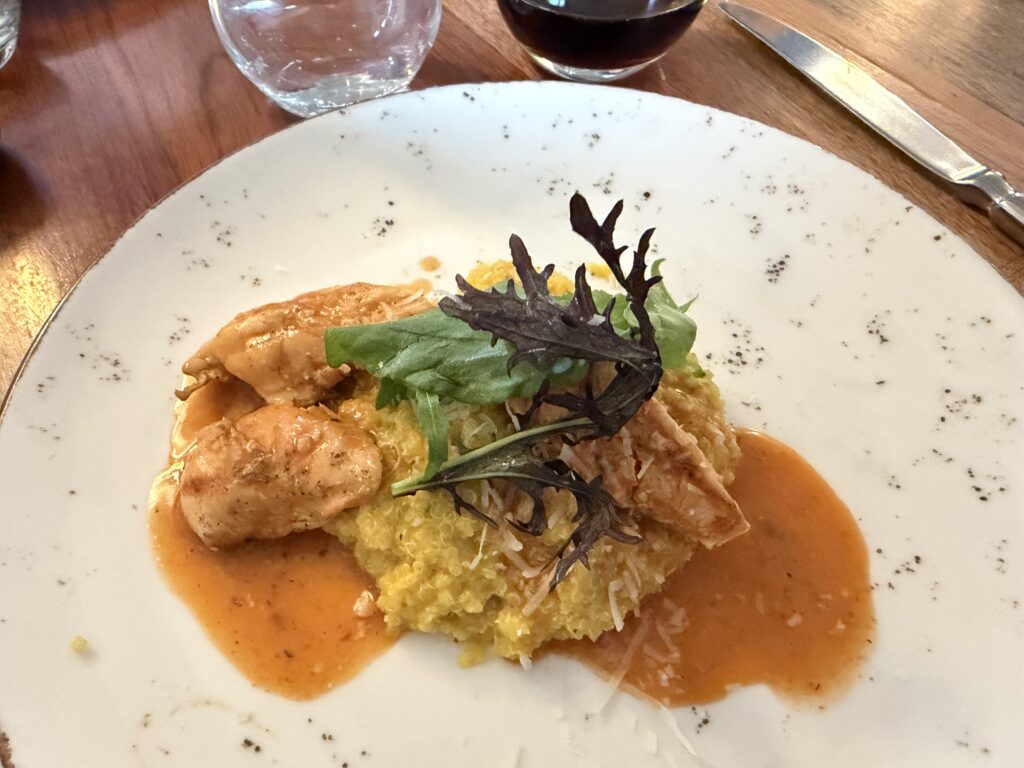
They served a gourmet lunch of Peruvian beef and chocolate mousse for dessert. The bar carriage was buzzing with a live band. As I sat there enjoying the views of the Urubamba River and the stunning scenery, I did relax into the specialness of it all.
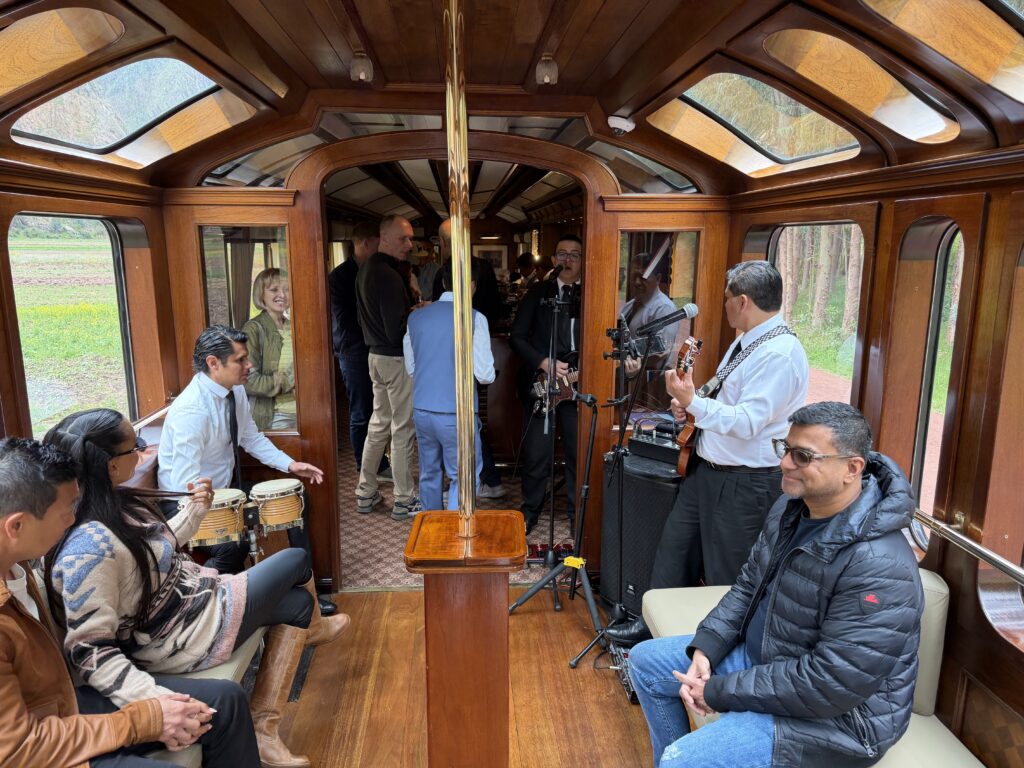
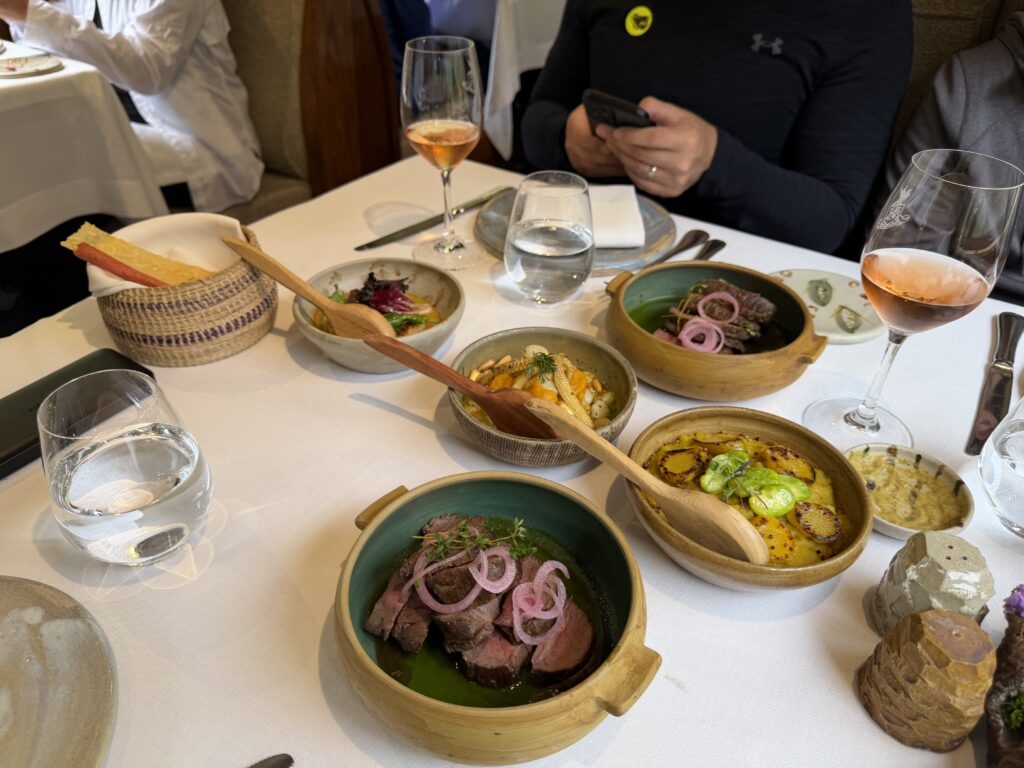
Though as soon as we reached Aguas Calientes, the town at the base of the mountain where Machu Picchu is, we were hurried though the town onto small buses for the 20-minute climb as we had arrived slightly late.
It is a scary road, with 14 hair-raising turns with steep drops and narrow passes. If a bus breaks down or a small rockslide occurs, the only road in and out is blocked.
We arrived at the top and entrance which was busy with people waiting for busses back down.
Then the final hurdle and unknown: the tickets and route we have got to go around Machu Picchu.
There are three different routes, and I knew that Route 2 is the “holy grail”, the most sought after. It gives you the iconic postcard view from the top we all know and weaves through all the key buildings and the major temples.
When our guide handed our tickets out, I was thrilled as I saw we had “Route 2”. Though I also noticed it was now 1:35pm and past our leeway time to enter. Our guide hurried us to the entrance and fortunately we were allowed through.
The guide tried to stop and talk about the mountains, history and show us orchids near the entrance, but I – like everyone else – was itching to move into the main citadel area.
Then he led us around a corner, and there it was.
Unlike the weather forecast had threatened, the clouds were only covering the highest mountain peaks leaving the ruins perfectly clear. And there was no rain.
It was silent, majestic, and due to combination of being there in the off-season and in the afternoon, it was unexpectedly uncrowded. Unlike many of the videos I had watched before going to prepare myself, it was not teeming and packed. In fact, it was almost as if we were just part of a small exclusive group exploring it.
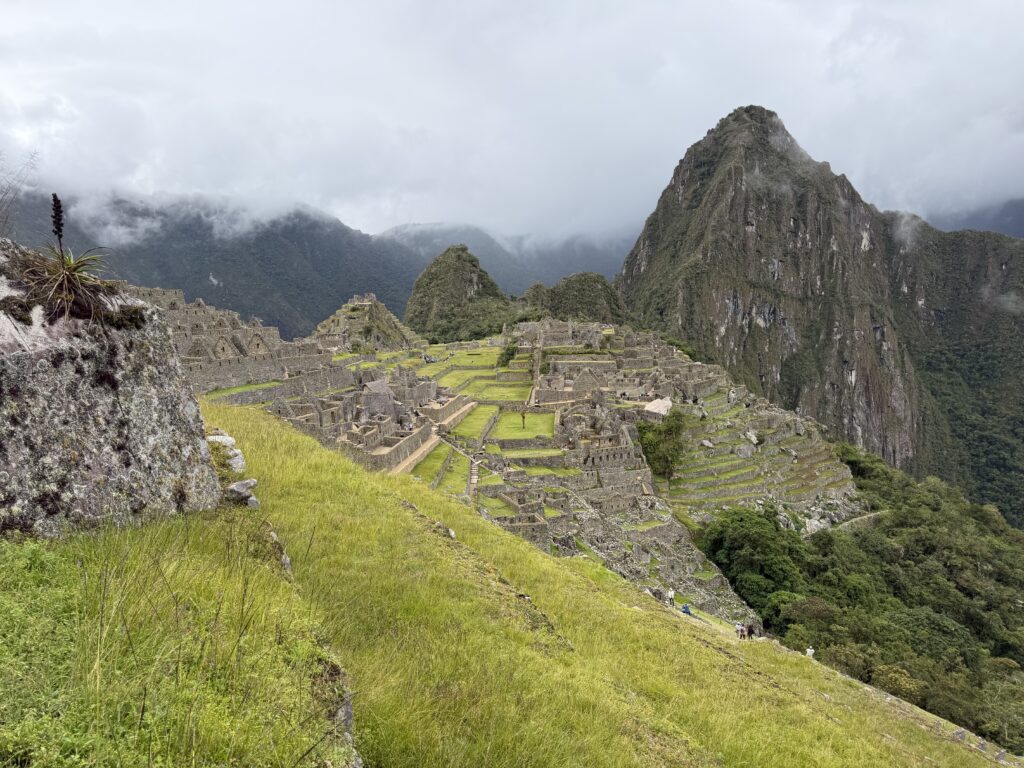
I didn’t feel the altitude at all; perhaps because Machu Picchu is lower than Cusco (it’s about 7,900 feet versus over 11,000 there), or perhaps it was just the excitement. My cold felt better even. The physical effort of the stone steps was totally manageable, and any thoughts of how much all this was costing evaporated as it was so magnificent.
But the clock was still ticking as Machu Picchu tickets now only allow around 3 hours on the site, and we did have a train to catch at 17:50pm from town. Though it did not feel rushed at all, and the guide took time explaining the history and what we were seeing. It felt a considered pace, giving time to bask in it all.
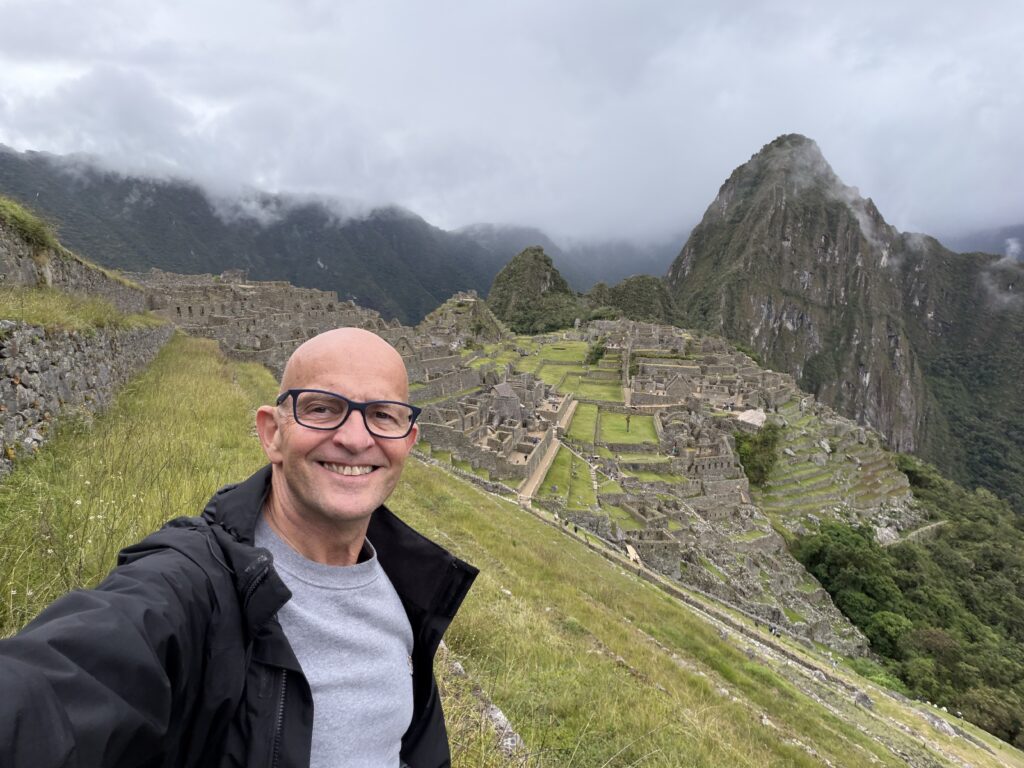
After exploring, we left to head to Belmond Sanctuary Lodge which is the only hotel right at the entrance, to have drinks and snacks also included in the excursion. As we entered the hotel it started to pour down with rain. Perfect timing.
We then hurriedly boarded the busses to head back down that winding road to catch the 5:50pm train. Time was tight and we hurried from the busses once in Aguas Calientes, arriving at the station as they were just about to open the doors to board the Hiram Bingham train.
The return journey was quieter. People were tired. I certainly was. An amazing 3-course gourmet dinner was served, the band was playing in the Observation Lounge and the bar still serving drinks, but there was a different energy now. More subdued as the long and busy day caught up with everyone.
Once we go to Rio Sagrado station and left the train it was another 90-minute coach back to Cusco, arriving at the hotel around 10pm.
And one final warning from our guide before bed. We had to be up early again.
Because the final, and perhaps one of the biggest, risks was still to come.
The $5,000 Verdict
The final day was that ultimate test. Getting back to the ship before it set sail for the next port at 2pm
If our flight from Cusco to Lima was delayed having done the tour through Holland America, the ship was likely to wait which took some stress out.
Especially when I saw several flights to Lima were very delayed. Luckily, ours wasn’t. I met some independent travellers off the ship at the gates who looked frazzled; their flight was delayed, and they knew the ship wouldn’t wait for them and things were looking tight. (I later heard they made it, but only by the skin of their teeth).
We made it back to the Oosterdam with an hour to spare.
As I mentioned my “Gold” Holland America solo excursion cost a massive $5,000. If I had booked it myself, I estimated it would have cost around $3,000 with flights around $150, Belmond Train including Machu Picchu Tickets around $1,200, 2 nights at the Belmond Hotel $1,500 and various Tours & Transfers. So, a big premium to have Holland America make all the arrangements and guide me though it all.
Was it worth it? For me, yes. The peace of mind, the seamless transitions, and the luxury of the Monasterio and the Hiram Bingham train turned a potentially stressful logistical independent nightmare into a once-in-a-lifetime adventure. I loved it.
Sign up to my Newsletter and never miss another post, and also get bonus tips, content, and offers not posted on the blog
Free and Premium Perk Options

Discover more from Tips For Travellers
Subscribe to get the latest posts sent to your email.