I Put The Luxury Belmond Hiram Bingham Train To Machu Picchu To The Test
 I Put The Luxury Belmond Hiram Bingham Train To Machu Picchu To The Test
While some hardy travellers do a gruelling multi-day trek through the Andes to get to Machu Picchu, most visitors catch the $200 return train from the closest main city of Cusco to Machu Picchu. But I decided to take a different path.
I took what’s considered the most luxurious train in South America, the Belmond Hiram Bingham to get there, costing $1,000 more.
Welcome aboard. I’m Gary Bembridge, and because this almost certainly would be the only time I’ll ever go to Machu Picchu, the moment I realised the journey to Machu Picchu required a train trip, and that there was a luxury option I was tempted by it.
Although before making the leap, I did dither wondering what an extra thousand dollars return was getting me, since every train from the basic $200 PeruRail Expedition Train to more premium options from Inca Rail would have got me to the same place.
Then I discovered two things that made me do it.
First, I realised the train is run by Belmond, the company behind some of the most iconic trains in the world including the Venice Simplon-Orient-Express, the Royal Scotsman, and the Eastern & Oriental Express. So, it should be something special.
And second, I found out it is named after the man who in 1911after being led to the ruins by locals, started studying them and made their existence known globally. It felt significant, historic, and connected to the place.
So, I booked it. But as I set off, reality started to hit.
Getting to the train wasn’t quite what I expected because of the time of year I was travelling. I went in March, which is during rainy season.
So, while the Hiram Bingham train departs from Poroy station on the outskirts of Cusco from May to December, where I like most people visiting Machu Picchu stay, I found my journey began with a ninety-minute bus ride through the Sacred Valley, including a short scenic stop, to reach Belmond’s private train station at Rio Sagrado.
For a while, I was disappointed as I had paid for a world-class rail experience but was sitting on a coach.
But then I arrived at the station. And things shifted.
There was a Peruvian band playing at the private and plush Rio Sagrado station. Champagne and snacks were being handed out.
Though it was a bit rushed as we had arrived just as the train was ready to board, but I felt there was an attempt to create a sense of occasion right from the start.
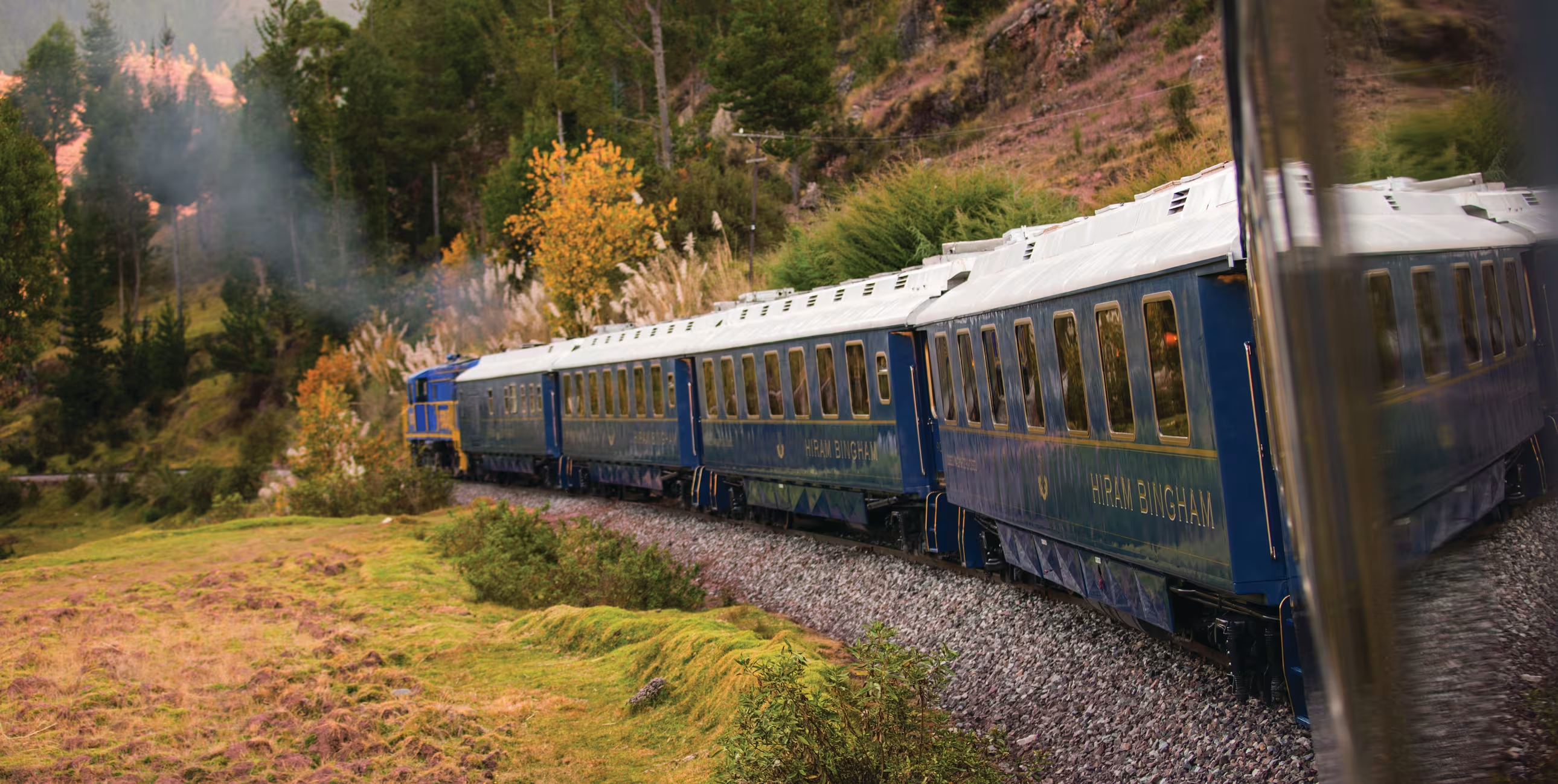
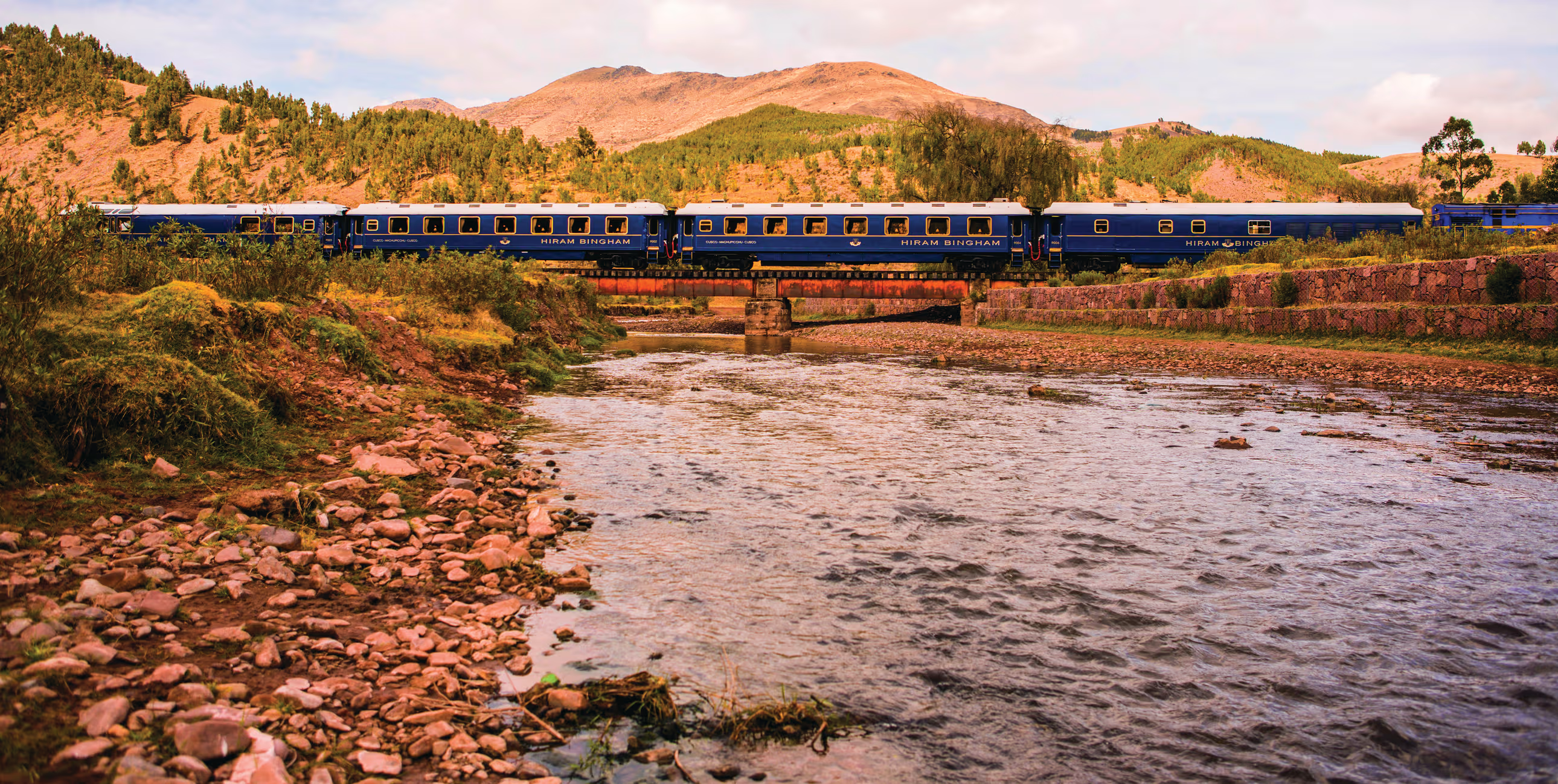
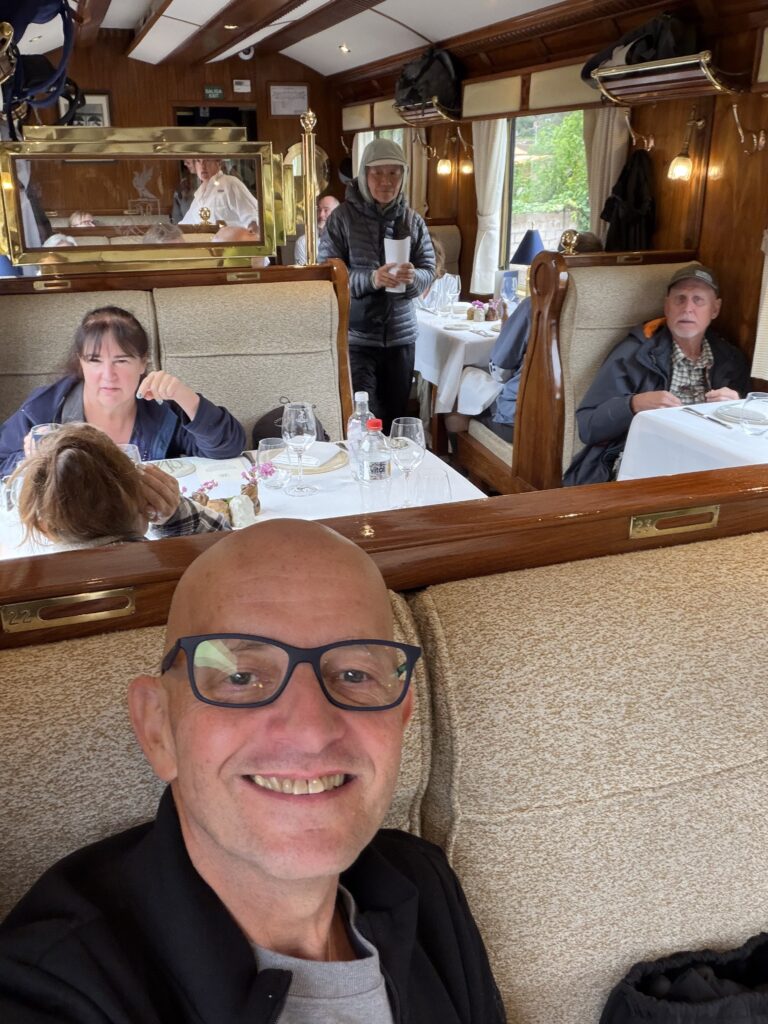
I caught sight of the blue and gold carriages, and as I stepped onboard for the roughly two-and-a-half-hour trip, immediately was impressed. The train had a wow factor.
This is not a big, mass-market train. It’s small and intimate. There was just a kitchen carriage, two dining cars, a bar car with observation carriage at the back, and three toilets.
The carriages are classic 1920s Pullman style — polished wood, brass details, elegant but not overly formal.
It carried only 84 passengers with tables in the dining carriages in two and four people configuration.
But as we began to move, the fragility of the experience became apparent. The tracks in this part of the world are far from top notch, and the train rocked and swayed as we started to move.
I was still though wondering if the on-board experience and inclusions would feel worthy of the hefty price tag.
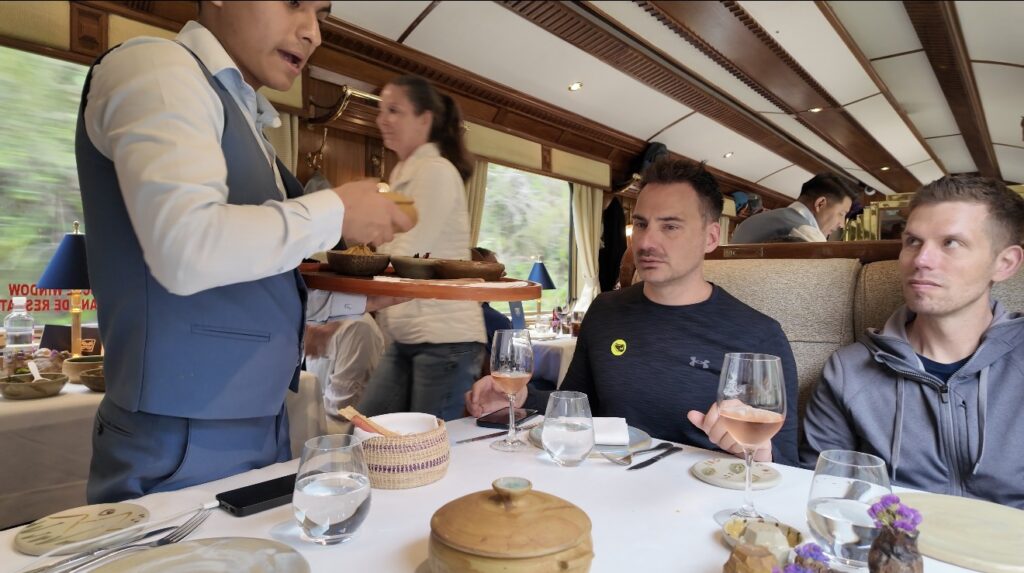
After some initial welcomes and commentary from the Train Manager, and at table drink service (All drinks are included in the fare), lunch was served about half an hour after departure, along with a selection of Peruvian wines.
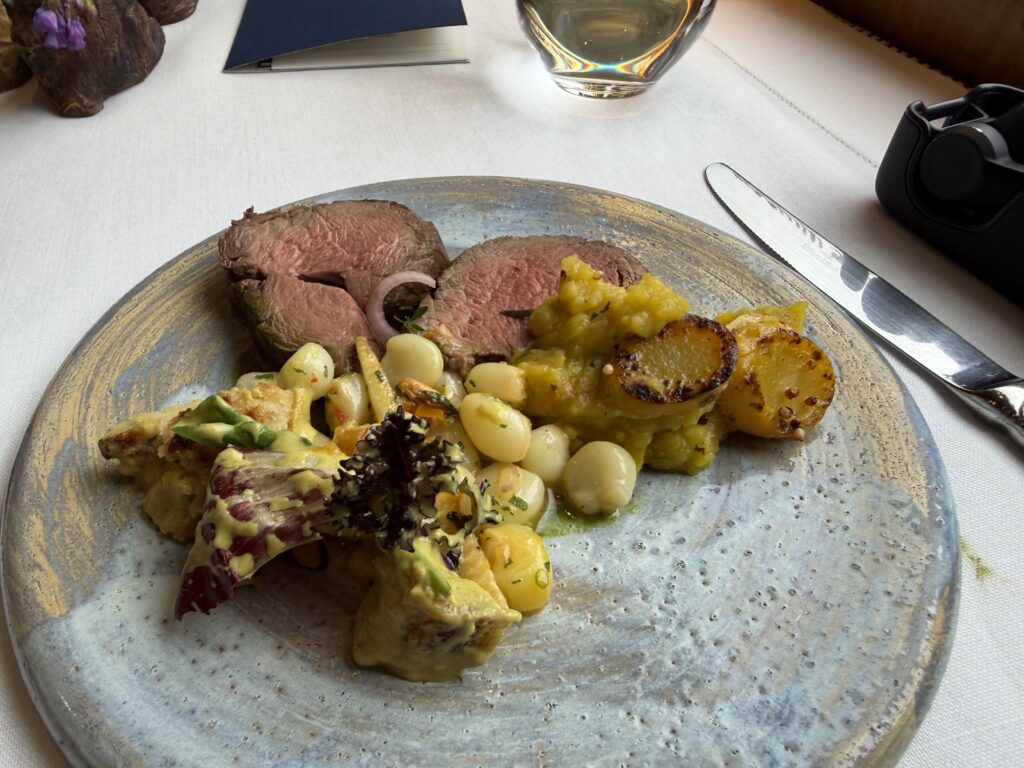
I was highly impressed with the food. It was up-market restaurant quality Peruvian cuisine, freshly prepared in the kitchen carriage along with attentive service.
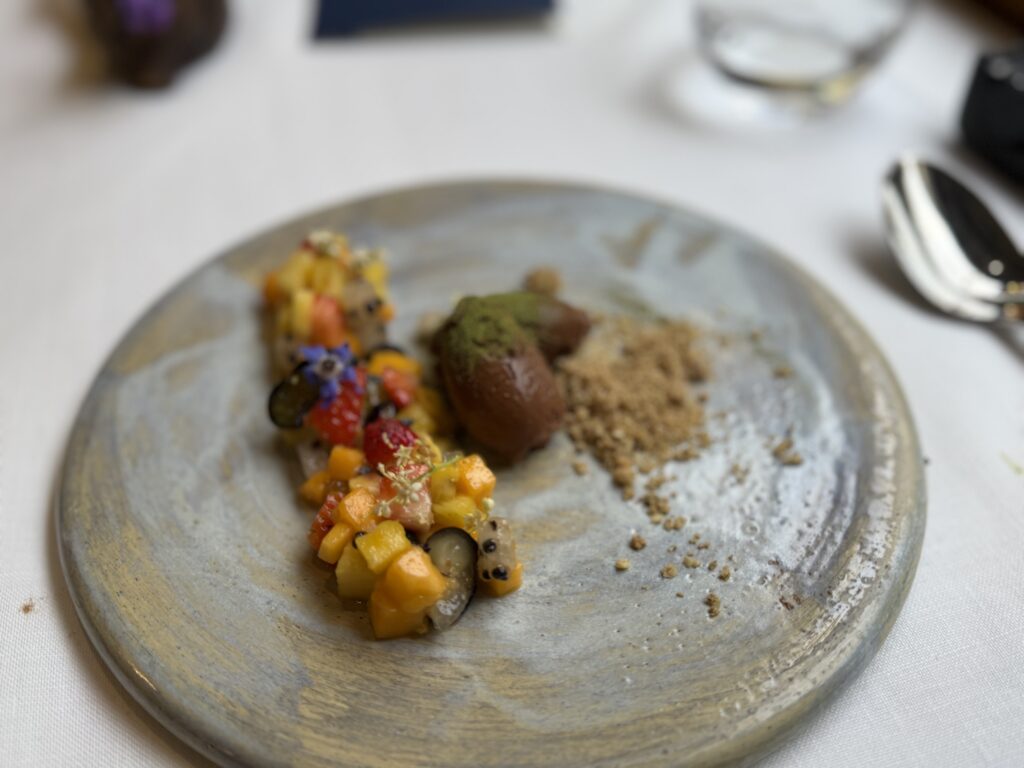
For lunch we had Beef Tenderloin with sides of Corn Ceviche, Mashed Olluco, and Cassava Tortilla. These were served as sharing platters, and the dessert was a stylishly displayed Chocolate Mousse plate.
But what surprised me as much as the food, was the atmosphere on the train.
The heart of this train isn’t the dining carriage; it’s the bar car.
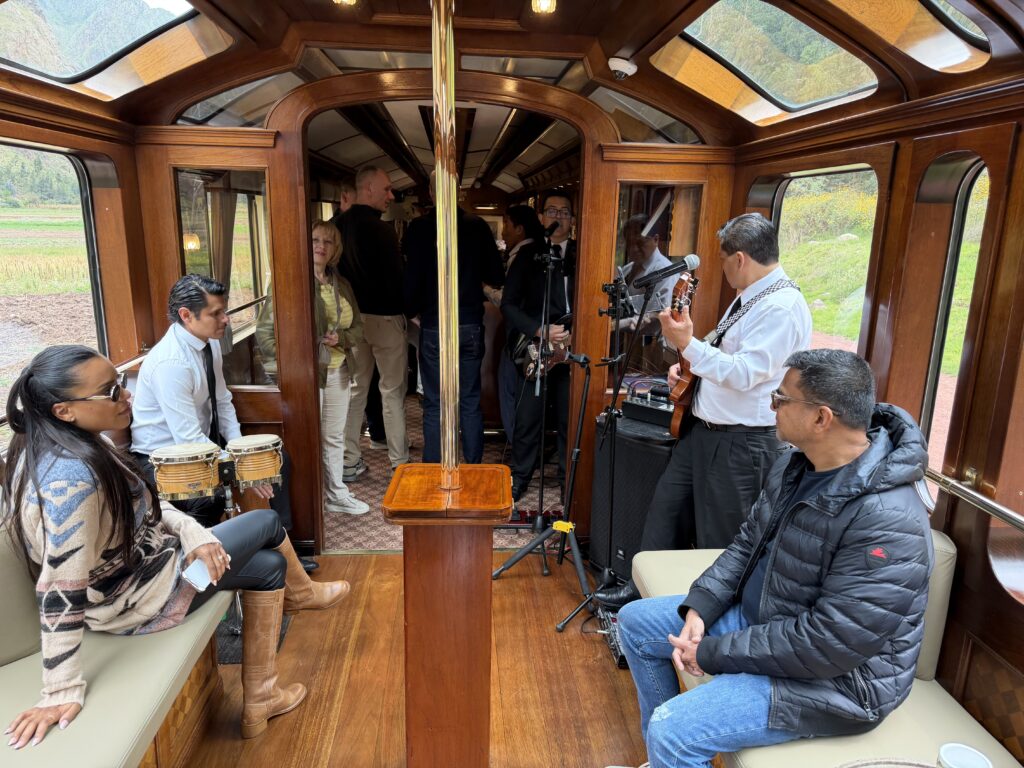
The bar car quickly became the heart of the journey, passengers drawn to the sounds of the 3-piece Peruvian band, the free-flowing Pisco Sours and cocktails, and the canapes being offered.
Passengers spread out between the sofa seating area, perched on the bar stools, and filled the Observation Deck at the rear of the Bar Carriage, which was open at the back with views down the tracks.
Along with other passengers, I spent much of my trip in the Observation Deck chatting to other excited travellers, taking photos, and watching the Urubamba River as it turned from a steady slow-moving river into a tempestuous series of rapids as the mountains grew taller as we progressed closer to Aguas Calientes, the gateway city below Machu Picchu.
Screenshot
In addition to the river, there were many fascinating sights along the way, the majestic Andes Mountains of course, farmlands, train depots, and the intriguing Sky Lodge Adventure Suites that hang precariously on the side of cliff faces, that travellers not afraid of heights can stay in.
With the included drinks flowing, people talking, mingling, and the undeniable buzz as we headed towards a once in a lifetime chance to see Machu Picchu, this train made the trip feel more like a celebration than a journey.
This is where I started to understand even more what Hiram Bingham train is trying to do.
Because while the scenery is the same as the less costly trains, the way you experience it is completely different. Hiram Bingham is not just transport. It’s an event.
An event that was made a little bit more special by two gifts we were given. A stylish Hiram Bingham bag and water bottle.
But still, in the back of my mind, of course the question remained. Is it worth it? Because the train trip itself is relatively short, around 2.5 hours each way.
Though once we arrived at Aguas Calientes for Machu Picchu, I saw first-hand more value in taking the Hiram Bingham train due to other inclusions and arrangements.
Unlike if I had travelled on one of the other trains that just get you to the Aguas Calientes, Hiram Bingham handle everything.
First, the tickets into Machu Picchu, which are hard to get. Numbers are controlled, the tickets have strict timed entry slots, and there are three routes, with Number 2 being the most desirable, which they obtain for their passengers.
Second, dedicated buses for their passengers to get up the steep road from Aguas Calientes to the Machu Picchu entrance, so no having to buy bus tickets and wait in line for a space on a bus.
And third a guided tour that is not included in a basic entry ticket.
Then after a few hours exploring, there was another included treat.
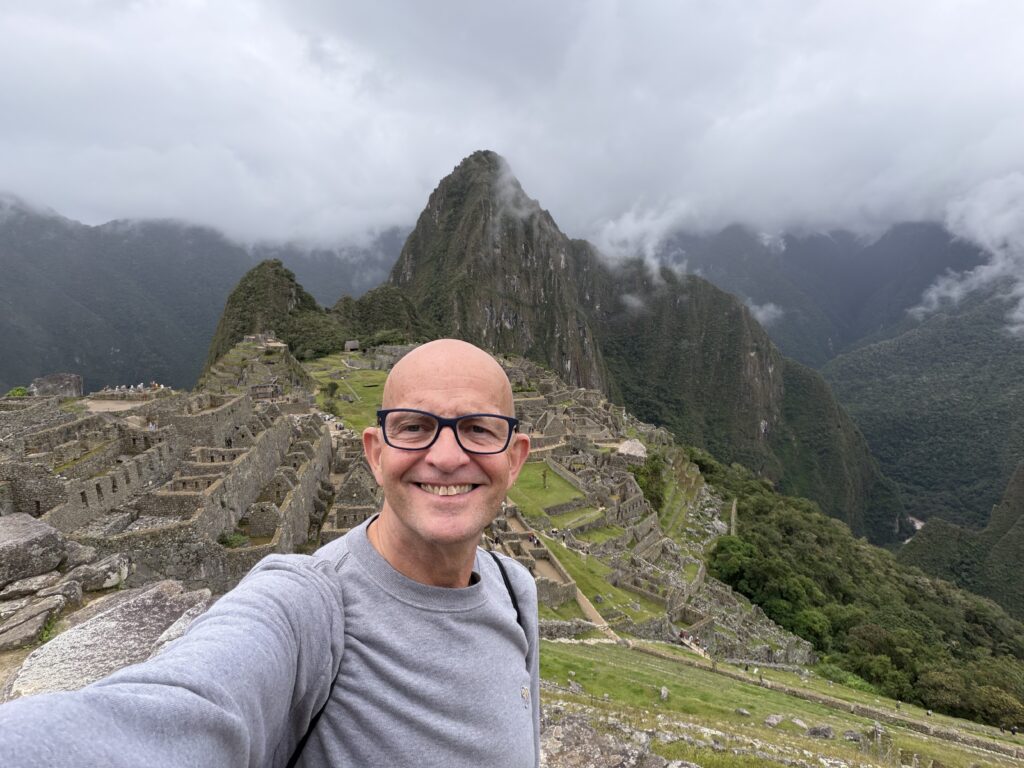
Cocktails and canapes stop at the only hotel located at the entrance of the site, the luxurious Belmond owned and run Sanctuary Lodge before catching the dedicated Hiram Bingham busses back down to Aguas Calientes to rejoin the train.
Timed to arrive just in time for the 17:50 departure I reboarded the train to the same table as on the way out.
Shortly after departure, a 3-course dinner was served. Again, an excellent meal freshly made in the kitchen carriage.
There was a salad starter with avocado, then a choice of Grilled Cured Trout or Duck in Tucupi Sauce. I chose the trout as it is a local regional speciality according to our guide, and the dessert was the rather unappealing sounding Corn Custard, which was in fact delicious.
The atmosphere was calmer on the return than on the way out as passengers were now more tired, and reflective. Though the bar was still serving included drinks and the 3-piece band were performing.
We pulled into Belmond’s private Rio Sagrado station at around 8:40pm, and after saying our farewells to the attentive crew, boarded our busses for the 1.5-hour drive back to Cusco. During the drive though still wishing I had travelled between May and December so I could have been on the train all the way to Cusco.
And somewhere on that journey back, I reached my conclusion.
As I thought back to the $200 more standard train. Those passengers saw the same scenery and the ruins. They had a wonderful time, I’m sure. But they also had to manage the stress, the lines, and the uncertainty of a complex Peruvian travel day and make Machu Picchu arrangements themselves. Mine were all bundled into the fare and sorted.
If you judge this purely as a train ride, it’s probably hard to justify. But that’s not really what this is.
This is a full-day, fully curated Machu Picchu experience. Transport, food, drinks, guiding, logistics, atmosphere – all wrapped into one seamless, carefully staged day.
For me, that made this once-in-my-lifetime trip to the famous Machu Picchu everything. It is something I’ll remember just as much as the place itself.
Sign up to my Newsletter and never miss another post, and also get bonus tips, content, and offers not posted on the blog
Free and Premium Perk Options
Discover more from Tips For Travellers
Subscribe to get the latest posts sent to your email.