I Was Completely WRONG About Sailing Ship Cruises. Here’s Why.
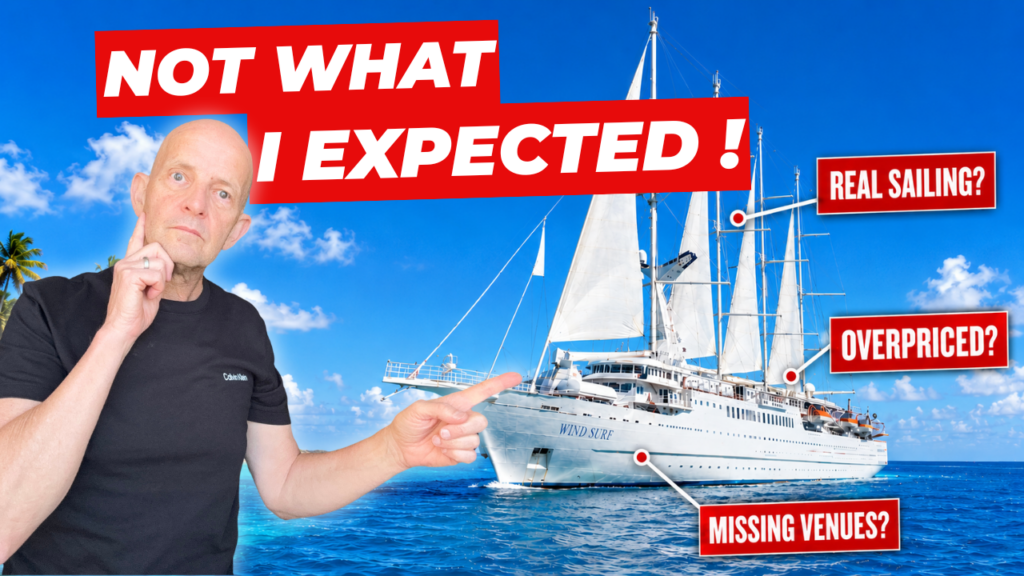 My Sailing Ship Cruise Tips And Watch Outs For First Timers
What I did not realise embarking on testing out cruising on a sailing ship was just how many of my assumptions going in were wrong. After going on over 100 regular ocean cruises, I decided to try one out to experience what I assumed would be rather different facilities, daily program, dining, and a very different feeling sailing with sails than with regular cruise ship engines. Here are my sailing ship cruise tips and watch outs based on that.
I decided to do my sailing ship cruise with Windstar. I had been on, and liked, their small 312-passenger regular cruise ships and knew they had three sailing ships. So, I booked a 8-night Venice to Rome cruise on their 342-passenger flagship five-mast Wind Surf.
On boarding I had my first assumption about regular cruise ships versus sailing ships blown apart.
Sailing Ship Cruise Tips: Not That Different?
I expected a sailing ship to be as different on the inside, because it looked so different on the outside to regular cruise ships.
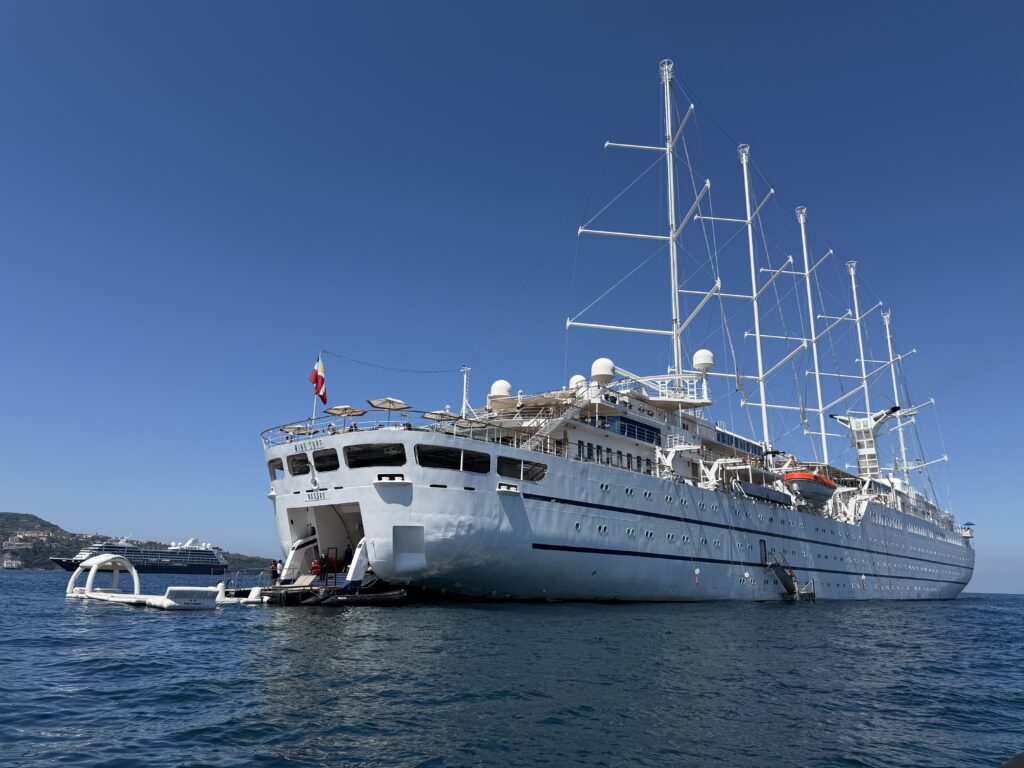
When I first saw Wind Surf on the boat transfer from the hotel to the Venice cruise port, it reinforced how unique compared to regular cruise ships sailing ships are, including the shape of the bow and there are masts rising above the hull instead of deck on deck of cabins.
But once on board it felt, and looked, surprisingly like regular cruise ships. And as the days unfolded, it operated similarly too.
There were some obvious and quirky differences that I will come to. But first, what felt the same?
The venues for one. There were all the ones that I expect on a regular cruise ship too.
There were several bars and lounges. They had Compass Rose Bar, The Lounge, and a Pool Bar. The lounge was laid out like a cabaret lounge where they did the shows and talks.
There was a cafe, the Yacht Club. There was a Fitness Centre and Spa. There was a pool deck with hot tubs. A shop. And of course, Guest Services, Excursions, and Future Cruise Desks.
When it came to dining, like many regular cruise lines, they had a Culinary Partnership, theirs’s being the James Beard Foundation, with various James Beard Award Winning Chef dishes on all the menus.
Like regular cruise lines, there were choices of dining venues.
There was the Veranda buffet open for breakfast and lunch with indoor and outdoor seating.There was the Amphora Main Dining Room open for dinner, with a generous menu of high-quality dishes.
It even had specialty dining. The Veranda became waiter-served Candles steak and seafood restaurant at night, and there was the French Stella Bistro.
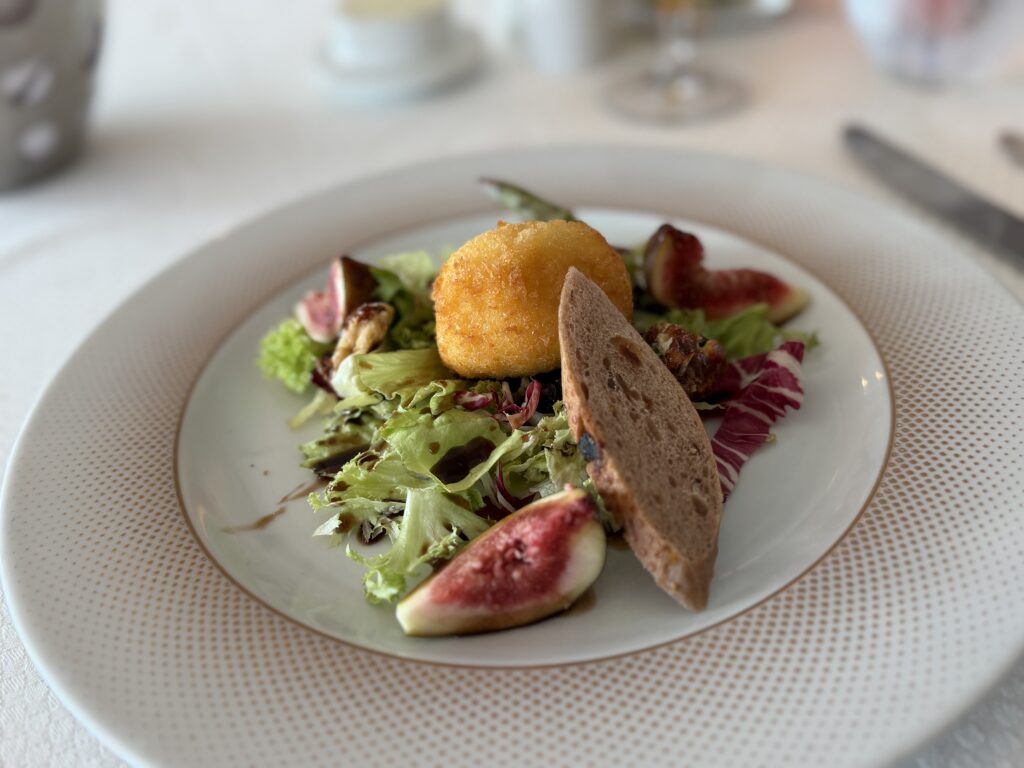
Of course, there was not as many choices of venues as on regular cruise ships which are larger and carry more people, but they had all the expected venues which all looked like they could have been on those ships too.
They were missing a few venues that some regular cruise ships have, like a Casino, Photoshop, Art Gallery with auctions, Kids’ Clubs, and features like rock climbing walls. But I have been on many regular cruise ships that do not have them either.
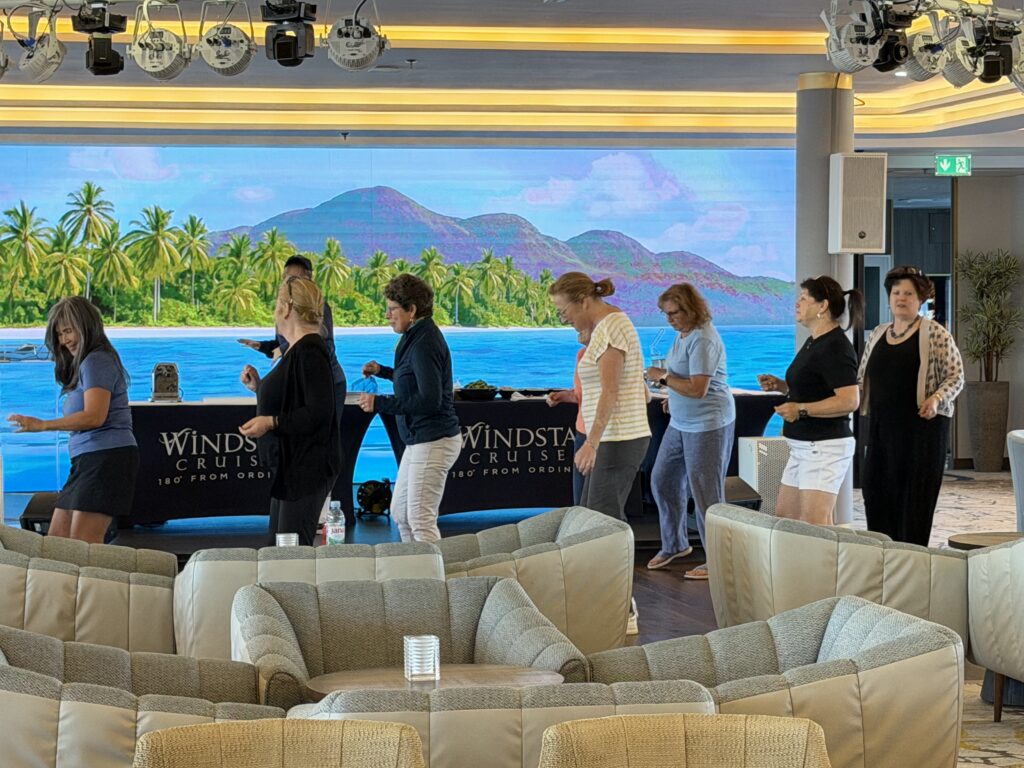
Also, when it came to the daily program, while there weren’t as many activities as on most regular cruise ships due to the number of guests and only having a Cruise Director and not a full entertainment team, it was basically the same set of activities.
We had trivia, dance classes, cooking demonstration, Galley Tour, Captain’s Welcome and Farewell Events, Captain’s Q&A, Port Talks, Excursion and Future Cruise Sales talks. They also brought some local cultural entertainers on board in Dubrovnik.
There was live music around the ship from a Saxophone Player, Pianist, and Dance Band Trio in the different bars and lounges in the evening.
And there were shows. They were nothing like on regular cruise ships, and much lower key. In fact, it was either the Cruise Director performing themed songs shows or from the on-board musicians. There were no guest entertainers, no production cast. And the Crew Show was seen by many as the main entertainment highlight.
What about some more stand out differences that struck me?
First, being on a sailing ship due to the design, layout, and being smaller, I felt more connected to the sea than when on regular cruise ships.
On regular cruise ships, especially newer ones, I sometimes almost forget I am at sea. The ships tend to be more internally focused, corralling us and focusing our attention inside rather than outside with dramatic atriums, often with no windows out to the ocean, with bars, cafes, restaurants and even theatres, casinos, and shops all radiating off or connected to them. Encouraging us to be in and active inside – and in the revenue generating parts of the ship.
On a sailing ship, the ocean is much more visible and accessible. You can just see it from every venue, and because there’s fewer activities versus regular cruise ships, I found people spent more time out on the decks watching the ocean, the coastline. And almost everyone is out on deck for sailaway when the sails come out.
Another key difference is the smaller range of cabin choices. None have a balcony and all have portholes. Unlike on regular cruise ships where balcony cabins are by far the main type.
Unlike those ships, all cabins were below the promenade deck, down in the hull of the ship, as the masts and sails are on top.
But even on a luxury sailing ship like Wind Surf, the cabins were smaller too, with the bathrooms being rather cosy.
There was a downside I found with a sailing ship linked to the smaller size, fewer venues and activities, and cabins not ideal for hanging out in. That was when the weather was less good, as I had the beginning of my trip where it was chilly, windy, and rainy, it felt less vibrant and a bit dull versus poor weather days on a regular cruise ship.
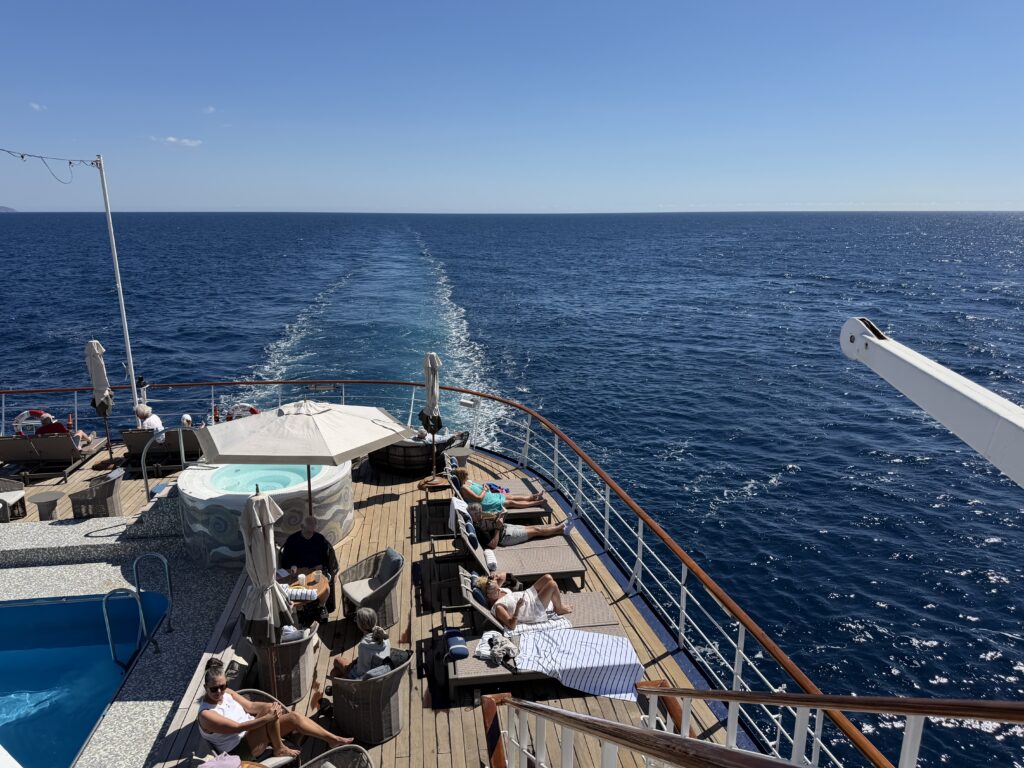
Sailing ships I found are best for warm sunny weather.
There was more dining outside than inside in the Veranda Buffet for breakfast and lunch. The Compass Rose bar had more space outside than inside, and so on. It is more about being outside enjoying the sailing or the scenery,
Another difference to regular cruise ships was the “Open Bridge” policy. Other than during sail in and sail out, I could just pop into the Bridge to talk to the team. On regular cruise ships it’s hard to get to the bridge, often reserved for Invited Guests or on paid-for behind scenes tours.
The ship also had a Watersports Marina at the back that was opened when the ship was anchored off ports.
Also, something I never experienced on any regular cruise ships was the watertight doors in the cabin corridors were always closed during sail in and out blocking passageways. So, I frequently had to use very specific stairs to get to my section of the passageway.
And then there was one massive thing that did not live up to my expectations and was not nearly as different to regular cruise ships as I had expected.
Sailing Ship Cruise Tips: Sailing Experience
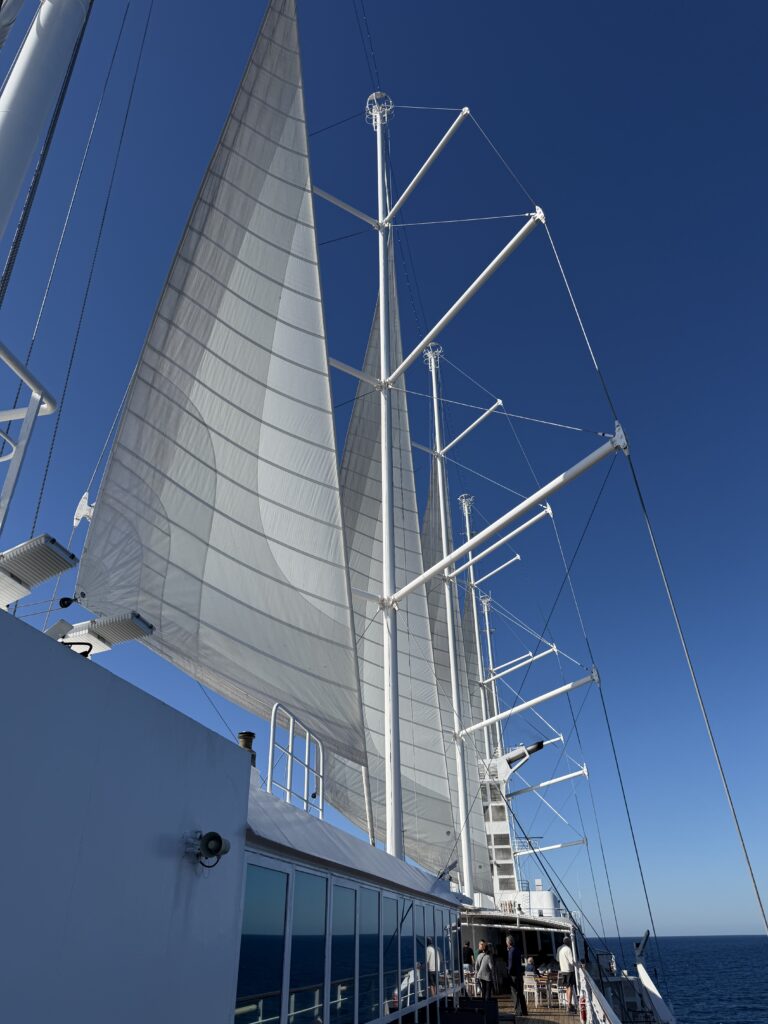
When I thought of sailing ships, I imagined unfurling of sails, with the crew up and down the rigging, the ship bobbing up and down and moving very differently thought the sea. But it was rather different.
As we set sail at the beginning of the cruise down the canal in Venice past St Mark’s Square, I had the first inkling that sailing was not going to be what I thought it was. Instead of the sails unfurling, they kind of rolled out slowly and mechanically. It was not as dramatic as I thought, and there was no crew involved.
It was clear is we were sailing under power, and the sails clearly were playing no real role in our movement as we sailed down that canal. And over the course of the cruise, I discovered this was mostly the case.
After visiting the bridge and from the Captain’s Q&A, I discovered that while in theory the ship could sail with just sails, they don’t.
They always sail under power to stick to the itinerary and because the weather or the wind is often not right to use sails. So, if there’s too much wind, it could damage the sails. If it’s too little, they offer little.
For example, on the one sea day we had, the Captain confirmed that the sails were out, but they were having no effect. They were there for show as that what guests expected. Though, it had been windy and in the right direction overnight and they had used the sails to reduce fuel usage.
I discovered that the ship could sail around 10 knots under power, and when the wind is right, sails can increase the ship’s speed by up to five knots. But they use the sails mostly to reduce fuel usage.
But the ceremony of putting the sails out when we sailed out of port became part of my cruise routine, even though I knew we were really operating under power like regular cruise ships do.
Also, the way the ship moved felt to me the same as on regular cruise ships. And while people I spoke to unfamiliar with smaller ships felt that there was lots of movement, I did not find it more than on smaller cruise ships I have been on.
That’s probably because like regular cruise ships, the Wind Surf has stabilisers. So, the motion was like what I was used to.
It quickly came home to me that if I want to get a true sailing ship experience, it only really happens on what are called Tall Ships. So, lines that I had discarded and not considered like Star Clippers and Sea Cloud.
Understanding that got me thinking about upsides being on this type of sailing ship with only 342 passengers was bringing.
Sailing Ship Cruise Tips: Small Ship Ups & Downs
Being on a sailing ship didn’t have as many upsides as I expected versus regular cruise ships to be frank.
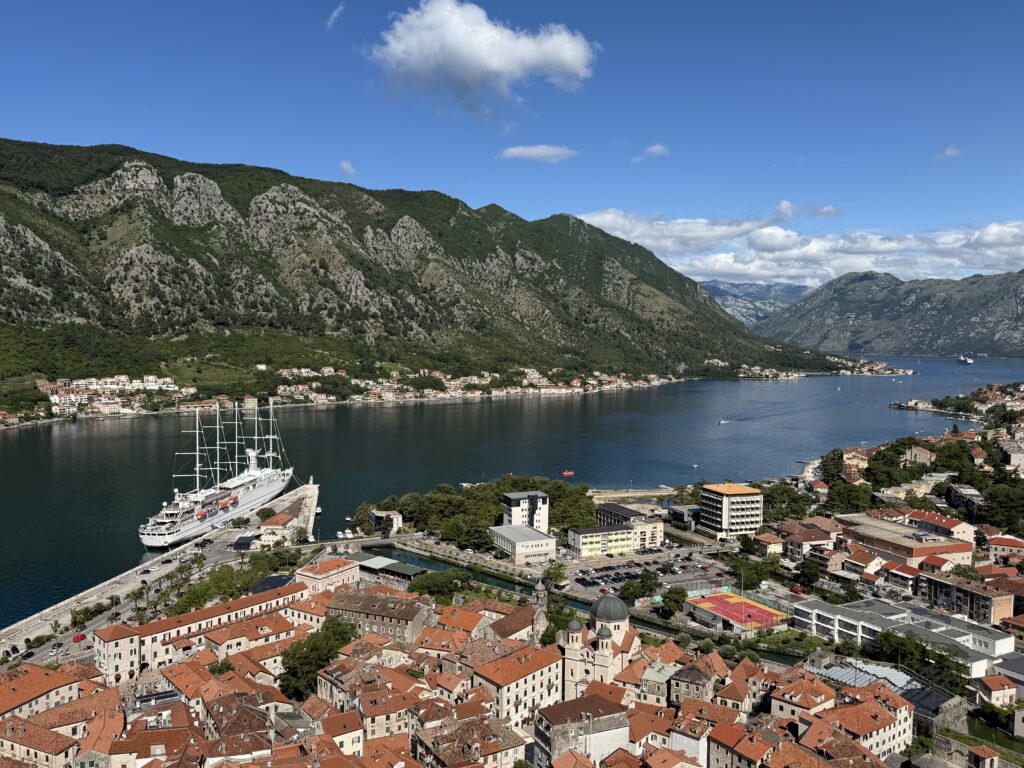
The two upsides touted are they have more interesting itineraries because they go to less called on towns and cities that even smaller regular cruise ships do not or cannot go to. This is because sailing ships can moor offshore and tender passengers in, they don’t need docks, infrastructure, and ports that can deal with and have things for hundreds or thousands of people to do.
Second, even if they do have to go to similar places as regular cruise ships, in many they can dock in the heart of cities or they can moor just outside and tender people in rather than being way out in working ports, which can be up to an hour away.
But both I found are rather mixed in practice.
Four out of the six ports on my Mediterranean itinerary were tender ports.
As I discovered this made the risk of missing a port higher, because if there’s a lot of wind or swell, they basically can’t run the tender service.
I saw that in two ports. In Dubrovnik we were due to moor right by historic Old Town, but it was too windy. Fortunately, as it was early in the season, there was a spare slot at the out-of-town port. Later in the peak season, that would have been unlikely.
In Sorrento, the swell was high, and it became challenging using tenders. I watched them struggling to embark people, and even tenders crashing into the tender platform. A lot of people didn’t find it comfortable getting to and from the Sorrento marina.
But also, even though I was on a small sailing ship, I found that if calling into places popular with other cruise ships or land-based tourists, the plus of being a small ship gets wiped out once in port.
For example, though we could dock in the heart of Venice which even smaller regular cruise ships cannot, out in Venice, it was rammed full of land and cruise tourists.
In Split Croatia, there were two large ships in (Costa and MSC) plus hordes of land-based tourists. So, the whole town was heaving and busy. So, I had to shuffle around like everybody else.This brings me to another issue that I faced. And this was cost.
Sailing Ship Cruise Tips: Price Of Sailing
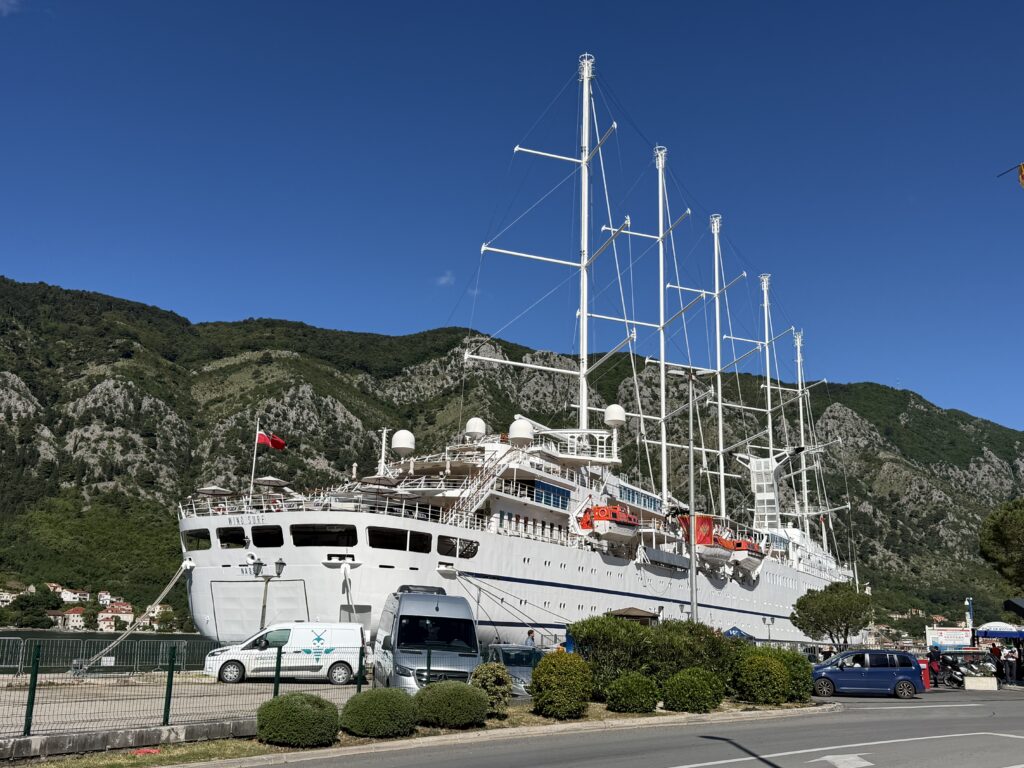
Going on a sailing ship is costly. My trip cost as much as a suite on most regular cruise ships, and even an entry level balcony cabin on many of the luxury lines.
Of course, I realised I was paying a premium to have only 342 guests and a more unique ship, but for me the compromise on the cabin versus what the money would buy on a regular cruise ships was challenging.
My trip cost just over $1,000 cruise only per night for two, this included specialty dining, soft drinks and coffees. But did not include drinks, Wi-Fi, and gratuities.
The cruise before this one was on a regular cruise ship, the 1,900-passenger Holland America Oosterdam costing the same $1,000 cruise only fare per night but got me a massive Neptune suite and various added perks like a special lounge access and Concierge.
So while I was struggling with value and what elements made it worthwhile, I spent time talking to people who clearly were loving and rated the experience as giving them value to find out what was common with them.
Sailing Ship Cruise Tips: Who Is It For?
The demographics of my fellow passengers was like many regular premium cruise lines I’ve been on, like the Holland America and Princess. A bit older, mostly couples, and mostly North American
But most did not see themselves as typical cruise people. They were destination and not ship focused and didn’t really value a lot of what regular cruise ships and lines offer like lots of choice, big shows and loads of activities. I saw this in how poorly attended most daily program events were, other than the daily port talks and briefings.
They also wanted to have a less “cookie cutter” and more unique ship, and cruise with as few people as possible. I met a lot of people who loved river cruises, so they were used to being on ships with fewer than 200 people.
They wanted to be in port exploring as much as possible and liked that a sailing ship itinerary had no or few sea days. We just had one.
The ship was pretty much deserted all day while in port, as they liked to be out on tours and self-exploring as long as they could.
This also meant they were way less bothered about the cabin than I was. It was not a place they spent time in, and valued more the casual, laid back, and informal nature, which included a relaxed dress code with only shorts really being a no-no for dinner.
Sign up to my Newsletter and never miss another post, and also get bonus tips, content, and offers not posted on the blog
Free and Premium Perk Options

Discover more from Tips For Travellers
Subscribe to get the latest posts sent to your email.